Marketing analytics is the practice of measuring, managing, and analyzing marketing performance data to improve ROI and drive better business decisions. In 2026, it has evolved beyond backward-looking dashboards into a real-time, AI-driven discipline — one where the insight and the action increasingly happen in the same automated loop, without waiting for a human to click approve.
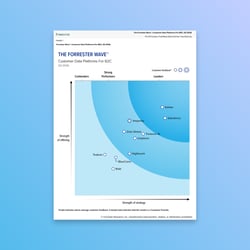
This guide covers what enterprise marketing teams need to know: what marketing analytics is, the four types that matter, which metrics to track, what tools to evaluate, and how AI agents are transforming the discipline right now. Treasure AI is a Forrester Wave™ Leader for B2C CDPs — trusted by 400+ global enterprises including Subaru, AB InBev, Nestlé, and JRE.
What Is Marketing Analytics?
Marketing analytics is the practice of collecting, measuring, and interpreting data about marketing activities to understand performance and improve future decisions. At its most basic, it answers questions like: Which campaigns drove the most revenue? Where are customers dropping off in the funnel? What is the return on this media spend?
More precisely, marketing analytics encompasses four disciplines — descriptive (what happened), diagnostic (why it happened), predictive (what will happen), and prescriptive or agentic (what should we do about it). Enterprise-grade marketing analytics platforms connect all four disciplines across a unified data foundation, so that insights from past behavior directly inform real-time decisions about the next customer interaction.
Marketing analytics is distinct from web analytics (which focuses narrowly on on-site behavior) and business intelligence (which typically covers the whole enterprise). It sits at the intersection of customer data, media performance, product behavior, and revenue impact — and it requires a data infrastructure capable of resolving identities across channels, devices, and time.
Why Marketing Analytics Has Changed in 2026
The fundamentals of marketing analytics have not changed — you still need to know what's working and why. But the technical and market conditions that determine how you do it have shifted dramatically in three areas.
Signal Loss & First-Party Data
Third-party cookies are gone (Google officially ended support for third-party cookies in Chrome in 2024). Mobile ad IDs are restricted. Walled gardens — Google, Meta, Amazon — return less data than they used to. The brands that adapted earliest did so by investing aggressively in first-party data collection: loyalty programs, email capture, on-site personalization, and direct customer relationships that generate behavioral signals they actually own. Marketing analytics built on first-party data is inherently more durable, more accurate, and more privacy-compliant than anything dependent on third-party identifiers.
The practical consequence: marketing analytics today requires a customer data platform (CDP) or equivalent first-party data infrastructure as a foundation layer. Without it, your analytics sits on shifting sand.
AI Agents That Act on Analytics
Until recently, analytics produced insights that humans acted on — eventually. A data team would build a churn-risk model, a marketing ops team would build a suppression list, and a campaign manager would suppress the list before the next send. That cycle took days or weeks. AI agents collapse this cycle to seconds.
In an agentic marketing architecture, the insight and the action are part of the same loop. A predictive model identifies a customer who is likely to churn; an AI agent immediately adjusts their next touchpoint — suppressing the promotional email and triggering a retention offer — without a human approval step. This is not hypothetical: enterprise brands using AI-driven decisioning are already operating this way at scale.
Real-Time vs. Batch: The Speed Gap That Costs Revenue
Batch analytics — running reports on yesterday's data, updating segment membership overnight — made sense when campaigns were weekly. It does not make sense when a customer is mid-session on your website right now. The speed gap between when something happens and when your analytics can see it determines whether you can act before the moment passes.
Real-time marketing analytics does not mean abandoning batch processing for aggregation and reporting. It means maintaining customer profiles that update in seconds, not hours, so that the next touchpoint — whatever channel it occurs on — reflects everything you know about that customer up to this moment.
The 4 Types of Marketing Analytics
| Type | Question Answered | Example | Typical Output |
|---|---|---|---|
| Descriptive | What happened? | Email open rates last quarter | Dashboard, report |
| Diagnostic | Why did it happen? | Why did Q2 CAC spike by 22%? | Root-cause analysis, cohort breakdown |
| Predictive | What will happen? | Which customers will churn in 90 days? | Scored audience, risk list |
| Prescriptive / Agentic | What should we do — and do it? | AI agent routes at-risk customers to retention flow automatically | Automated action, real-time trigger |
Most enterprise marketing teams have invested in descriptive and diagnostic analytics. The competitive gap in 2026 is in predictive and prescriptive capabilities — and specifically in closing the loop so that predictive models feed directly into automated, agentic actions without human handoff delays.
1. Descriptive Analytics
Descriptive analytics is your rearview mirror: what happened, to whom, when, and across which channels. Campaign performance reports, funnel conversion dashboards, and channel attribution summaries all fall here. This is table stakes — every marketing team has some version of it. The challenge is that most enterprise teams have descriptive analytics fragmented across dozens of tools that don't share a common customer identifier, making it impossible to get a coherent view of a customer's full journey.
2. Diagnostic Analytics
Diagnostic analytics goes one layer deeper: not just what happened, but why. When paid search ROAS drops 15% quarter-over-quarter, diagnostic analytics helps you determine whether it was audience saturation, creative fatigue, competitor bid changes, or a product issue that drove up refunds. It requires the ability to slice data by dimensions — audience segment, geography, device, creative variant, purchase history — and requires a data foundation that links media data to product and CRM data.
3. Predictive Analytics
Predictive analytics uses historical patterns to forecast future behavior. Common applications include churn prediction, next-best-offer scoring, lifetime value estimation, lead scoring, and demand forecasting. These models are only as good as the data they're trained on — which is why first-party customer data, unified across channels and sources, dramatically outperforms models trained on siloed data from a single channel.
4. Prescriptive / Agentic Analytics
Prescriptive analytics recommends an action. Agentic analytics takes it. This is where the category has moved in 2026: rather than producing a recommendation that a human reviews and acts on (with all the latency that entails), agentic marketing systems use AI agents to execute decisions in real time — adjusting personalization, triggering communications, modifying bid strategies, or routing customers — while maintaining human oversight at the policy level rather than the individual-decision level.
Three concrete examples of AI agents in production at enterprise scale:
- Churn prevention: A customer's engagement score drops below a threshold. An AI agent detects the signal, checks their purchase history and predicted churn probability, and within minutes routes them to a retention journey — suppressing the next promotional email and triggering a personalized offer — without a human approval step.
- High-LTV lookalike expansion: An AI agent identifies behavioral patterns in your top 10% customers and automatically builds and activates a lookalike audience across paid channels — updating daily as new high-value customers are acquired, so your paid media always targets the profile most likely to become a long-term revenue driver.
- Real-time cart abandonment: A customer adds three items to cart then goes idle. An AI agent detects the abandonment signal, checks their purchase history and churn risk score, and within 60 seconds triggers a personalized recovery offer on the channel they're most likely to respond to — without a human touching the workflow.
Key Marketing Analytics Metrics
The right metrics depend on your business model, customer journey length, and growth stage. The following groupings cover the most important categories for enterprise marketing teams.
Acquisition Metrics
- Customer Acquisition Cost (CAC): Total marketing and sales spend divided by net new customers in a period. Rising CAC is often the first signal that a channel is saturating or that targeting quality has declined.
- Return on Ad Spend (ROAS): Revenue attributable to advertising divided by advertising spend. Most useful as a channel-level metric when combined with a reliable attribution model.
- Cost Per Lead (CPL): Total spend divided by qualified leads generated. In B2B contexts, "qualified" is often the key variable — CPL without a quality filter can optimize for volume at the expense of pipeline value.
- Channel Mix Efficiency: Which channels are acquiring customers at what cost, and how does customer quality (long-term retention, LTV) vary by acquisition source?
Retention Metrics
- Customer Lifetime Value (CLV / LTV): The total predicted revenue from a customer over the course of the relationship. LTV is the strategic anchor for acquisition spend — a channel worth paying $200 CAC for a customer worth $1,200 LTV may be worth losing money on a $300 CAC for a customer worth $450 LTV.
- Churn Rate: The percentage of customers who stop purchasing in a given period. For subscription businesses, even a 1-percentage-point reduction in monthly churn has compounding revenue impact.
- Net Promoter Score (NPS): While a satisfaction metric rather than a revenue metric directly, NPS cohorts consistently show higher retention and referral rates among promoters, making it a leading indicator for LTV.
- Repeat Purchase Rate: The percentage of customers who make a second purchase. In DTC and retail, this is often the single most important signal of whether the first purchase is building a relationship or just a transaction.
Attribution Metrics
- Multi-Touch Attribution (MTA): Distributes conversion credit across multiple touchpoints in the customer journey. More accurate than last-click, but requires identity resolution to stitch together cross-channel, cross-device journeys.
- Marketing Mix Modeling (MMM): Statistical modeling at the aggregate level to measure the contribution of each marketing channel to overall revenue. Not customer-level, but valuable for top-of-funnel channels (TV, out-of-home) where individual attribution is impossible.
- Incrementality Testing: Holdout testing to measure the actual causal impact of a marketing activity — i.e., what would have happened without this spend? Incrementality is the gold standard for understanding true marketing ROI, not just correlation.
Marketing Analytics by Channel
Different marketing channels generate different data signals — and require different analytical approaches. Here is what enterprise teams need to measure across the most important channels.
Email Marketing Analytics
Email analytics go beyond open rate and click rate — which are increasingly unreliable due to Apple Mail Privacy Protection inflating open metrics. The metrics that matter for enterprise email programs:
- Click-to-open rate (CTOR): Clicks divided by opens — a cleaner engagement signal than open rate alone
- Revenue per email sent: Total attributed revenue divided by emails delivered — the clearest measure of email program ROI
- List health metrics: Hard bounce rate, unsubscribe rate, spam complaint rate — leading indicators of deliverability risk
- Segment lift: Conversion rate of personalized vs. broadcast sends — quantifies the value of your segmentation program
Paid Media Analytics
Paid media analytics in 2026 must account for signal loss from cookie deprecation and walled garden data restrictions. Key metrics:
- Return on Ad Spend (ROAS) by channel: Revenue attributable to each paid channel — requires a reliable attribution model to be meaningful
- Incrementality lift: The causal revenue lift from paid media, measured via holdout testing — separates true media impact from organic behavior
- Frequency and reach efficiency: As walled garden audiences become more expensive, controlling frequency and expanding reach without saturation is critical
- Audience match rate: The percentage of your CDP audiences that successfully match in each paid media platform — a direct measure of first-party data quality
Social Media Analytics
Social analytics has shifted from vanity metrics (likes, followers) to business-outcome metrics. Enterprise social analytics programs track:
- Share of voice: Your brand's mentions relative to competitors across social channels
- Social-attributed conversions: Requires linking social engagement to CRM identity — only possible with a CDP that resolves cross-channel identities
- Content performance by audience segment: Which content formats and topics resonate with which customer segments — feeds directly into personalization strategy
Web and Product Analytics
Web analytics answers on-site questions; product analytics answers in-product questions. For enterprise marketing teams, both feed into a unified marketing analytics view:
- Conversion funnel by acquisition source: Where are users dropping off, and does it vary by channel? Requires linking web behavior to acquisition data
- Cohort retention: Do customers acquired from different channels retain at different rates? This is the insight that reorients budget from lowest-CAC to highest-LTV acquisition
- Feature and content engagement: Which product features or content pieces correlate with higher LTV or lower churn — feeds directly into personalization and retention programs
Marketing Analytics Examples from Enterprise Brands
Abstract frameworks only go so far. Here is how three global enterprise brands have applied marketing analytics — with specific, measured results.
Subaru: 350% CTR Lift from Unified Customer Data
Subaru had rich customer data — service records, ownership history, financing information, digital behavior — spread across disconnected systems. They could not assemble a single customer profile that would let them know, for instance, that a customer who brought their car in for service six months ago was now in-market for a new vehicle. By unifying these data sources into a single customer view, Subaru could deliver personalized messaging at the right moment in the ownership and purchase cycle. The result: a 350% increase in click-through rates on targeted campaigns. Not from spending more on media — from making each impression more relevant.
AB InBev: 2,000 Sources Unified, 90 Million Records
AB InBev, the world's largest beer company, operates across dozens of markets with hundreds of brands and an enormous range of consumer touchpoints: retail, on-premise, digital, events, loyalty. Consolidating 2,000 data sources into a unified customer profile — encompassing 90 million records — gave their marketing teams a foundation for analytics that was simply not possible when data lived in fragmented point solutions. The unified layer enables global reporting, local personalization, and the kind of cross-market pattern recognition that is only visible when data is genuinely connected.
Nestlé: AI-Driven Personalization at Consumer Scale
Nestlé's Latin American markets deployed AI-driven personalization across their digital marketing programs, leveraging unified first-party data to move from broadcast messaging to individually relevant content at scale. The ability to analyze individual preference signals — product categories, engagement patterns, purchase timing — and act on them in real time transformed their digital marketing from a static content distribution operation into a dynamic, responsive consumer engagement engine. Nestlé's results confirm what the data consistently shows: personalization at scale requires unified data and automated execution — neither alone is sufficient.
JR East (Japan Railway): 110 Million Cards, 17 Million Loyalty Members
Japan Railway East operates the Suica card network, one of the world's largest contactless payment and transit ecosystems, with 110 million Suica cards in circulation and 17 million JRE loyalty members. The behavioral data generated by transit, retail, and payment interactions is extraordinary in its volume and regularity. Turning that data into a coherent analytics foundation — one that can support personalized offers, loyalty optimization, and targeted communications — required both the infrastructure to handle data at that scale and the analytical capability to extract signal from the noise.
Marketing Analytics Software & Tools: What Enterprise Teams Are Evaluating in 2026
Choosing the right marketing analytics software is one of the highest-stakes technology decisions a marketing organization makes — the wrong choice means fragmented data, manual exports, and analytics that can't keep pace with how customers actually behave.
The marketing analytics software landscape in 2026 spans point solutions (channel-specific analytics), analytics platforms (cross-channel reporting and attribution), and full-stack customer data platforms (CDP) that serve as the data foundation for all analytics above them. Evaluating marketing analytics tools requires clarity about which layer of the stack you're solving for.
The Marketing Analytics Software Landscape
Enterprise teams typically evaluate tools across three layers of the stack, and the names that appear most often in RFPs reflect distinct purposes:
- Web analytics layer: Google Analytics 4 and Adobe Analytics remain the dominant tools for on-site and in-app behavioral measurement. They're essential for digital measurement but operate at the session and event level — not the unified customer profile level.
- Attribution and media mix: Rockerbox, Northbeam, and Triple Whale have emerged as the leading independent attribution platforms for brands managing significant paid media budgets across Meta, Google, TikTok, and emerging channels. These tools solve specifically for cross-channel media attribution and marketing mix modeling.
- Composable activation layer: reverse ETL and data activation tools are widely used to sync audiences and insights from data warehouses (Snowflake, BigQuery, Databricks) to activation channels — filling the gap between where data lives and where campaigns run.
- Full-stack CDPs: Segment, mParticle, and Treasure AI combine identity resolution, behavioral data collection, audience segmentation, and activation into a unified platform. For enterprise teams, the key differentiators are scale, data warehouse integration depth, AI/ML capabilities, and activation breadth.
Point solutions solve individual problems well. The challenge for enterprise marketing teams is that assembling four or five best-of-breed tools creates integration overhead, introduces latency between layers, and fragments the customer identity that real-time personalization and AI-driven decisioning require. A full-stack CDP eliminates the integration tax and provides a single customer profile that every analytics and activation layer can query — which is why enterprises with complex, multi-channel customer journeys consistently find that a unified platform outperforms a stitched-together point-solution stack.
Evaluation Criteria for Marketing Analytics Software
| Criterion | Why It Matters | What to Ask |
|---|---|---|
| Identity Resolution | Cross-channel analytics requires linking the same customer across touchpoints and devices | How are anonymous and known profiles merged? Deterministic or probabilistic? |
| Data Freshness | Real-time decisions need near-real-time data; batch-only limits use cases | What is the latency from event to available profile attribute? |
| Data Warehouse Compatibility | Enterprise data lives in Snowflake, BigQuery, or Databricks — tools that require data copies create risk and delay | Does the platform support zero-copy architecture or native warehouse integration? |
| AI/ML Capability | Predictive and prescriptive analytics require native or deeply integrated ML | Is ML built in, or a separate purchase? Can custom models be deployed? |
| Activation Layer | Analytics is only valuable when it drives action — how does insight reach the channel? | How many native channel integrations? What is the audience sync latency? |
| Compliance & Governance | Enterprise analytics must satisfy GDPR, CCPA, HIPAA (in relevant industries), and SOC 2 | SOC 2 Type 2 (not just Type 1), GDPR, CCPA, HIPAA for healthcare — and how consent is propagated to downstream activations |
Traditional Stack vs. CDP-Powered Analytics
| Capability | Traditional Stack | CDP-Powered Analytics |
|---|---|---|
| Customer Identity | Siloed per channel; manual stitching required | Unified persistent profile across all channels and devices |
| Data Freshness | Typically T+1 or T+7 batch | Real-time or near-real-time (seconds) |
| Attribution | Last-click or single-channel; no cross-device journey view | Multi-touch, cross-device, cross-channel journey attribution |
| Predictive Models | Separate ML platform; manual operationalization | Built-in or natively integrated; models feed directly into segments and activations |
| Activation | Manual CSV exports; multi-day delay from insight to campaign | Automated real-time audience sync to 400+ channels |
| AI Agents | Not supported; human handoffs at every step | AI agents act on unified data; human oversight at policy level |
| Data Warehouse Fit | Often requires copying data out of warehouse into vendor silo | Composable architecture runs directly on Snowflake, Databricks, or BigQuery |
| Governance | Consent fragmented across tools; compliance requires manual reconciliation | Centralized consent and suppression propagated to all downstream activations |
Treasure AI's Intelligent CDP is designed specifically for enterprise teams that need analytics to run at this level of sophistication. Its Hybrid CDP architecture means it operates as both a Composable CDP — running directly on your Snowflake, Databricks, or BigQuery environment with zero-copy data access — and as a complete end-to-end platform for teams that prefer a fully managed solution. With 400+ native integrations, it is built for the way enterprise marketing analytics actually needs to work in 2026.
Treasure AI's AI Agent Foundry lets enterprise teams build, test, and deploy AI agents on unified customer data — without writing custom model infrastructure. Agents can be deployed for audience discovery, churn prediction, campaign optimization, and real-time personalization. Learn more about AI Agent Foundry →
Treasure AI was recognized as a Leader in the Forrester Wave™ for B2C CDPs, Q3 2024 — reflecting the platform's strength across customer data unification, AI capabilities, and enterprise activation.
B2B Marketing Analytics: What's Different
B2B marketing analytics shares the same four analytical types and many of the same metrics as B2C — but the customer model is fundamentally different, and that changes how analytics must be built.
The most important structural difference: in B2B, the customer is an account (a company), not an individual. Multiple stakeholders — economic buyers, champions, technical evaluators, procurement — participate in a single purchase decision. Marketing analytics that only tracks individual touchpoints misses the account-level dynamics that actually drive conversion. Account-level reporting requires identity resolution that links individuals to accounts and tracks account-wide engagement signals.
Key differences in B2B marketing analytics include:
- Account-Based Analytics: Segment performance and pipeline influence reported at the account level, not just the contact level. Engagement scoring at the buying-committee level, not just the individual lead level.
- Longer, More Complex Attribution Windows: B2B sales cycles run from weeks to years. Attribution models must accommodate multi-month, multi-touch journeys where the first touchpoint may precede conversion by 18 months.
- Marketing-to-Pipeline Linkage: The most critical B2B marketing analytics question is often not "what drove leads?" but "what drove closed revenue?" This requires integrating marketing data with CRM data (Salesforce, HubSpot) and tracking marketing influence on opportunity creation and progression.
- Intent Data Integration: B2B marketing analytics increasingly incorporates third-party intent signals (G2, Bombora, TechTarget) alongside first-party behavioral data to identify in-market accounts before they identify themselves through direct engagement.
- Tighter ICP Definition: Because B2B deal values are high and sales cycles are long, the cost of acquiring the wrong customer is much higher than in B2C. Analytics that identifies ideal customer profile (ICP) fit early — and suppresses non-ICP accounts from expensive outreach — drives disproportionate efficiency gains.
Digital Marketing Analytics in 2026
Digital marketing analytics has always meant measuring online channel performance — paid search, social, email, display, SEO, content. In 2026, "digital" is nearly synonymous with "all marketing," as even traditionally offline channels (TV, out-of-home, events) generate digital signals that feed into analytics models.
Several trends are reshaping digital marketing analytics specifically:
Generative Engine Optimization (GEO): With AI assistants — ChatGPT, Gemini, Perplexity — now handling a meaningful and growing share of information queries that previously flowed through Google Search, digital marketing analytics must evolve to measure visibility and influence in AI-generated responses, not just traditional search rankings.
Consent-Mode Analytics: As privacy regulation tightens globally, digital analytics must operate accurately even when a meaningful percentage of users decline cookie consent. Modeling approaches — statistical imputation, consent-mode API integration — are now required capabilities, not optional enhancements.
Cross-Channel Journey Visibility: A customer might see a display ad, search organically, engage with a LinkedIn post, open a nurture email, and convert through a paid branded keyword — all as part of a single journey. Digital marketing analytics that lives in channel-specific silos cannot see this journey. Only a unified customer data layer with cross-channel identity resolution can.
Streaming Event Data: Website behavior, mobile app interactions, and product usage events generate high-velocity streaming data that batch-ETL pipelines cannot process fast enough for real-time use cases. Enterprise digital marketing analytics platforms in 2026 require native streaming ingestion alongside batch processing.
AI-Augmented Analysis: Natural language querying, automated anomaly detection, and AI-generated insight summaries are reducing the analyst bottleneck — making it possible for marketing managers to ask data questions and get reliable answers without writing SQL or waiting for a data team report.
How to Build a Marketing Analytics Strategy
A marketing analytics strategy is not a technology decision. It is a program — combining data infrastructure, analytical capability, organizational process, and activation systems — that ties marketing activity to business outcomes. Here are the five steps that consistently appear in high-performing enterprise marketing analytics programs.
- Define Your Business Questions First
Start with the decisions your marketing leadership actually needs to make: Should we shift budget from paid social to email? Are we acquiring customers with above-average lifetime value from this channel? What is causing the conversion rate decline in this segment? Analytics strategy that starts with data collection rather than business questions produces dashboards no one uses. - Audit and Unify Your Data Foundation
Inventory every marketing data source: CRM, marketing automation, paid media, web analytics, CDP, data warehouse, product analytics. Map which customer identifiers are used in each system. Identify the joins that do not exist — the gaps that prevent you from connecting a customer's paid-media exposure to their in-product behavior to their customer service history. The audit will reveal where unified identity resolution is most urgent. - Establish the Metrics That Connect Marketing to Revenue
Every marketing metric should have a line of sight to a revenue or retention outcome. CAC matters because it determines payback period relative to LTV. Channel mix matters because different channels acquire customers with materially different long-term value. Define the primary metrics (typically 5–8) that your team will be accountable to, and resist the temptation to measure everything. - Build the Activation Loop
Analytics that does not drive action has no value. For each key analytical output — churn-risk scores, high-LTV acquisition segments, campaign performance signals — define the automated action that should follow. Who sees the insight? What is the workflow that converts it into a marketing action? How quickly? The goal is to shrink the time from insight to action from days to seconds wherever possible. - Invest in Incrementality and Causal Measurement
Correlation-based analytics — this channel had the highest ROAS, therefore it is performing well — is vulnerable to selection bias and attribution gaming. As your analytics program matures, invest in holdout testing and incrementality measurement to understand the true causal impact of your marketing spend. This is what allows you to make defensible budget allocation decisions, not just report on what happened.
Marketing Analytics Readiness Checklist
- ☐ Single customer identifier across CRM, ESP, and web analytics
- ☐ First-party data collection strategy independent of third-party cookies
- ☐ Real-time or near-real-time profile updates (under 5 minutes)
- ☐ At least one predictive model in production (churn, LTV, or propensity)
- ☐ Automated activation: analytics output → channel action without manual export
- ☐ Incrementality testing program for at least top 3 channels by spend
Frequently Asked Questions
What is marketing analytics, and why does it matter?
Marketing analytics is the collection, measurement, and interpretation of data about marketing activities to improve decisions and outcomes. It matters because marketing spend without analytics is allocation by intuition — and intuition at scale is expensive. Organizations with mature marketing analytics programs consistently outperform peers on marketing efficiency, customer retention, and revenue growth.
What are the best marketing analytics tools for enterprise teams?
The right marketing analytics software depends on your stack and maturity. Enterprise teams typically need three layers: a customer data platform (CDP) for unified identity and first-party data management, an analytics and attribution layer for multi-touch reporting and modeling, and an activation layer for syncing audiences to channels. Platforms that combine all three — like a Hybrid CDP with built-in AI and 400+ integrations — reduce data lag and operational complexity compared to assembling separate point solutions.
How is B2B marketing analytics different from B2C?
B2B marketing analytics must operate at the account level, not just the contact level, because purchasing decisions involve multiple stakeholders. It also requires longer attribution windows (months to years rather than days to weeks), tighter integration with CRM pipeline data, and intent-signal layering to identify in-market accounts before they self-identify. B2B marketing analytics platforms need to link individual engagement to account-level engagement scores and pipeline influence metrics.
What is the difference between marketing analytics and web analytics?
Web analytics (Google Analytics, Adobe Analytics) measures on-site or in-app behavior: sessions, pageviews, conversion events. Marketing analytics is broader — it connects web behavior to media spend, CRM data, purchase history, and customer lifetime value across all channels, not just what happens on your website. Web analytics is typically one input into a marketing analytics program, not a replacement for it.
What metrics should a marketing analytics strategy prioritize?
Start with the metrics that connect marketing to revenue: Customer Acquisition Cost (CAC), Customer Lifetime Value (CLV), Return on Ad Spend (ROAS), and Marketing-Sourced Pipeline (for B2B). Add channel-specific metrics for optimization (CPL, CTR, conversion rate) and retention metrics (churn rate, repeat purchase rate) for full-funnel visibility. Resist measuring everything — five to eight well-chosen metrics that the full team understands are more valuable than fifty metrics that live in a dashboard no one reviews.
How do AI agents fit into marketing analytics in 2026?
AI agents represent the evolution from prescriptive analytics (recommending actions) to agentic analytics (taking actions automatically). In practice, this means AI agents that monitor analytical signals — a churn-risk threshold crossed, a high-value segment identified, an anomalous ROAS drop — and take pre-authorized actions in real time: adjusting audiences, triggering communications, modifying bids, or routing customers to different journey paths. The human role shifts from approving individual decisions to setting the policies, guardrails, and objectives that govern what agents are authorized to do.
Ready to Upgrade Your Marketing Analytics?
Enterprise marketing analytics at the level described in this guide — unified customer profiles, real-time activation, AI-driven decisioning, predictive modeling on first-party data — requires the right data foundation. Treasure AI's Intelligent CDP is built specifically for enterprises that need analytics to close the loop between insight and action at scale.
Whether you're starting with a composable architecture on your existing data warehouse or looking for an end-to-end managed platform, Treasure AI supports both deployment models — with the same unified customer data, the same AI Agent Foundry, and the same 400+ channel integrations either way.
Treasure AI maintains SOC 2 Type 2 certification and supports GDPR, CCPA, and HIPAA-compliant data processing.
See how brands like Subaru (350% CTR lift) and AB InBev (90M records unified) have built their marketing analytics foundation on Treasure AI — or request a custom demo tailored to your industry and use case.
Not sure where to start? Treasure AI offers a complimentary CDP RFP Template and transparent, no-compute pricing — so you can evaluate fit before committing.