Build an AI-First Growth Engine in 30 Days

Speed is now the marketing advantage. This white paper is a 30-day playbook for shortening the time from signal to action, with a daily calendar, five pipeline questions, and AI prompts to run this week.
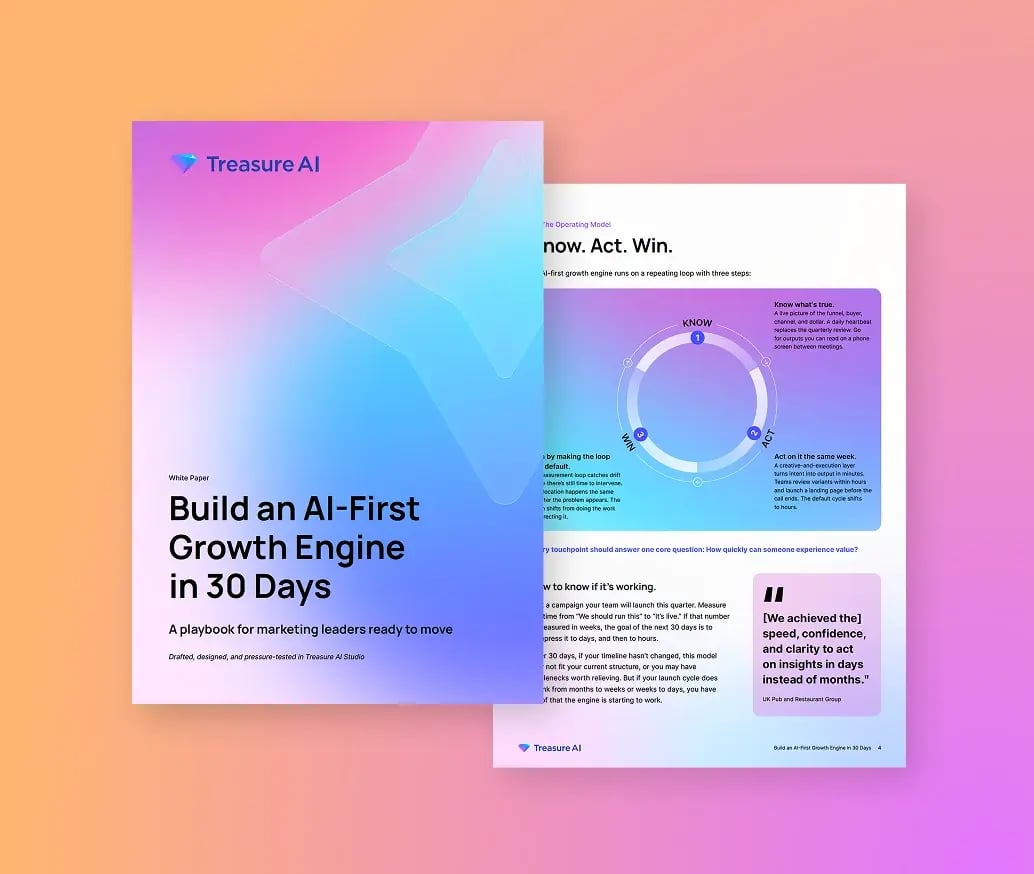
Build an AI-First Growth Engine in 30 Days

Speed is the new advantage in marketing

Legacy CMO vs. AI-first CMO

Legacy CMOs manage the plan. AI-first CMOs direct the engine.

Legacy CMO versus AI-first CMO: how behaviors will change
Capability Legacy CMOManages the plan. AI-First CMODirects the engine.
Default cycle Weeks.Briefs, agencies, slideware. Hours.Prompts, drafts, live tests.
Source of truth Quarterly review. Live signal.
Who does the work Functions hand off. Agents do the first pass.People decide.
Creative Briefed. Reviewed.Shipped late. Drafted in minutes.A/B’d by lunch.
Measurement Reported at the QBR. Watched in week two.
Buyer unit A lead. A buying group.
Channels Volume that looks good. Signals that convert.
Brand posture Polished. Static. Modern. In motion.
Know Act Win

Know. Act. Win.

An AI-first growth engine runs one repeating loop. Know what's true with a live view of funnel, buyer, channel, and spend. Act on it the same week, with creative and execution measured in hours. Win by making the loop the default, so drift is caught and budget moves within the same quarter.

Days 15–25: Brand, story, and data

Rewrite copy to invite action, not announce capability. Name one source for every metric and set drift alerts.

Speed is already showing up in results


Five questions to uncover pipeline this week

Each question comes with a prompt you can paste into any AI tool connected to your CRM, marketing automation, or paid-channel data.

What you'll probably find: Job title, even when optional, often marks a higher-converting cohort. Making it required is a one-checkbox change.

Prompt: Compare conversion rate to closed-won for demo requests where Job Title was filled vs blank over the last 90 days. What changes if Job Title becomes required?

What you'll probably find: A few geographies or referral sources produce meaningful volume and zero pipeline.

Prompt: List every demo source over the last 12 months. Rank by closed-won rate. Flag any source with significant volume and zero deals.

What you'll probably find: At least one asset converts to opportunities at a rate close to zero.

Prompt: For each gated asset, show the rate at which downloaders become opportunities. Treat each asset as its own cohort.

What you'll probably find: Branded and category search is the highest-converting paid line and one of the smallest budget lines.

Prompt: Show our top-converting paid keywords by closed-won. Find the category keywords where we don't rank in the top three but our competitors do. Suggest ten new ones.

What you'll probably find: A paused campaign with tens of thousands of historical clicks at low CPC. Reactivating it is a same-week change.

Prompt: List every paused paid-search campaign with positive historical performance. Rank by total clicks at the time of pause. Draft a relaunch brief for the top three.

Test a 10% shift this quarter

Move 10% of paid budget away from channels that ask buyers for nothing, and toward channels that earn a signal: search intent, registration, or real evaluation. Measure same-quarter pipeline. The paper expects a lift without added spend, so treat it as a test, not a promise.


Test a 10% shift this quarter

FAQs

A marketing operating model that runs one repeating loop: know what's true, act on it the same week, and make the loop the default. Success is measured by how fast a campaign goes from idea to live.

Thirty days, following the calendar in Appendix A. If your launch cycle hasn't shortened by then, the paper suggests your model may not fit your structure, or a bottleneck needs relief.

No. The prompts work in any AI tool with read access to your CRM, marketing automation, or paid-channel data, including Treasure AI Studio, ChatGPT, Claude, and Gemini.

Every claim in a plan, slide, or campaign traces to a named source, and that source is named when the claim is made. If two numbers disagree, explain the gap instead of averaging it.

The paper recommends targeting a buying group of three to four stakeholders per in-market account, and cutting influencer personas that inflate lead volume without closing deals.

No. Download it without a form.

Start with the first question on Monday

You may find new pipeline by Friday.