More marketing.
Less operational drag.

Give your marketing team more capacity for analysis, campaigns, and creative ideas. Digital Workers, your AI marketing teammates, take on defined tasks—so your people can focus on direction, decisions, and improvement.

dw

Digital Workers

What is a Digital Worker?

An AI teammate with a defined role, goals, skills, and boundaries. It takes on tasks using your customer data and business context, and returns results for your team to review.

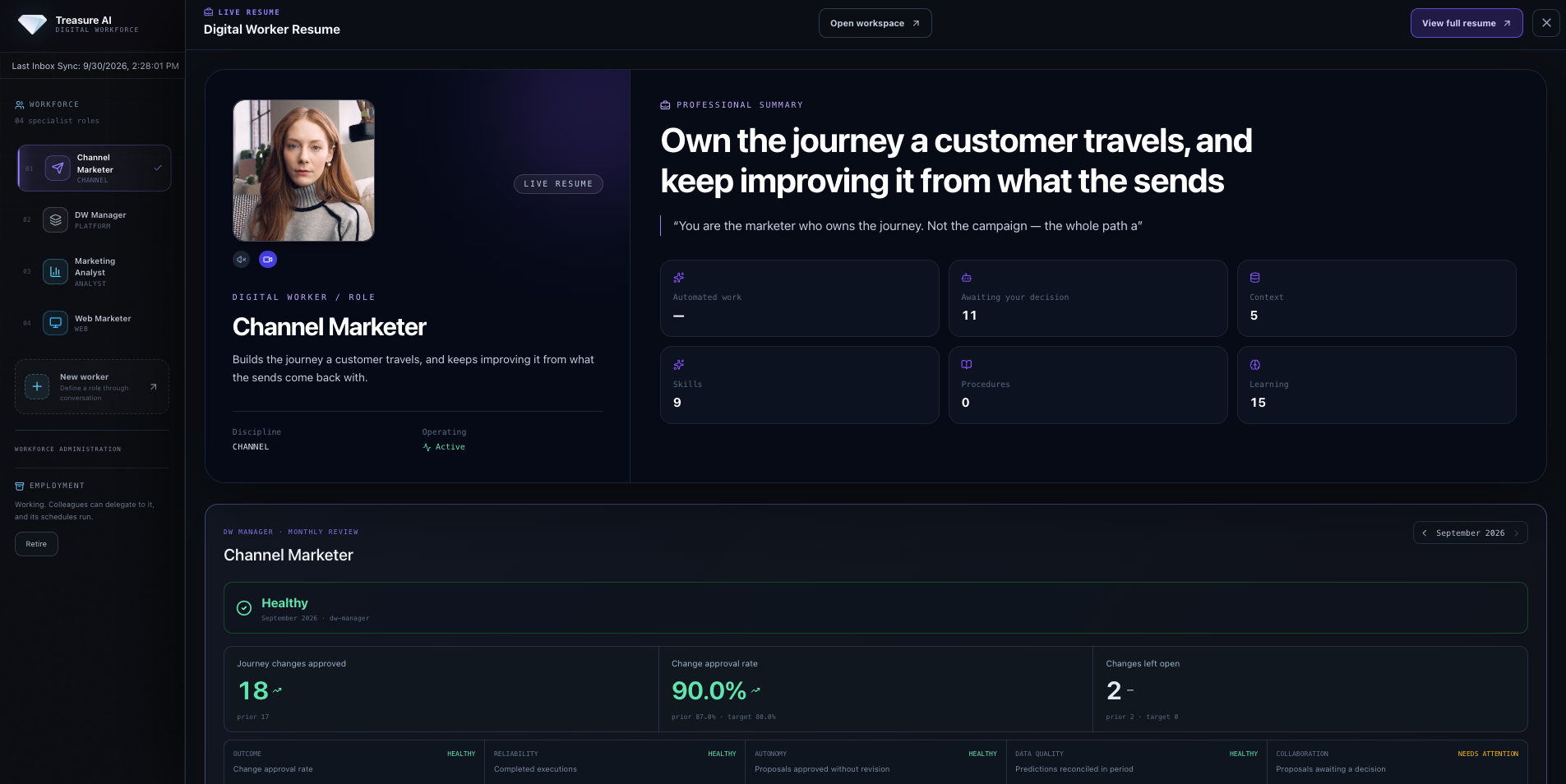
Channel Marketer profile showing the role and its description.

Marketing Analyst

Understand what changed in repeat purchases.

Ad hoc task

“Why did repeat purchases fall in Japan last week?”

Scheduled task

“Every Monday, compare repeat purchases by market.”

A strong place to start

Your team reviews

Is the interpretation sound? Is the proposed audience useful?

Channel Marketer

Turn a campaign brief into a draft.

Ad hoc task

“Draft three messages for our repeat-purchase campaign.”

Scheduled task

“Every Monday, draft follow-ups for approved campaign briefs.”

Your team reviews

Does the message fit the audience, the brand, and the intended journey?

Web Marketer

Turn an agreed idea into a page draft.

Ad hoc task

“Draft a landing page for our repeat-purchase campaign.”

Scheduled task

“Every Friday, draft page updates from approved content briefs.”

Your team reviews

Is the content accurate, on brand, and ready for publication?

Watch the demo

See a Digital Worker in action.

As you watch, think of one task you’d stop doing step by step. The demo starts at 26:20.

Watch on YouTube
Recorded presentation · YouTube player loads when you press play.

From software assistance to delegated tasks

Give AI responsibility for a defined task.

Expand your team’s capacity while you hire—or while hiring is on hold. Make proven methods repeatable, and schedule defined tasks to run while you’re away. Your team sets boundaries and reviews the results.

Before

Software helps your team execute the task.

Your team operates the software Your team defines, executes, and reviews the task. Repeated clicks, drags, and drops across SaaS interfaces are illustrated by software windows, cursors, and drag paths. Your team uses the software to investigate, prepare, and return a deliverable. Your team Define · execute · review InvestigatePrepareReturn Drag. Drop. Repeat. 1,000 times.
Your team operates SaaS interfaces, step after step.

After

A Digital Worker takes on a defined task.

Your team delegates execution to a Digital Worker Your team defines the task and reviews the result. Within the defined task, the Digital Worker is an AI agent that uses software to investigate, prepare, and return a deliverable before human review. Agreed guardrails define data access, tool permissions, and human approval points. Your team Define · review DEFINED TASK Digital Worker AI AGENT InvestigatePrepareReturn Within agreed guardrails Data accessTool permissionsHuman approval
Execution is delegated. Direction and review stay human.

Less time operating software. More time deciding what marketing should do next.

Start with one recurring business question, then review the findings together.

The platform underneath

Powered by Headless.
Built to take on defined tasks.

Less re-explaining. More building on what your team knows. Connect defined tasks to agreed customer data and business definitions through Treasure AI Studio and Headless.

Explore Treasure AI Headless
Human-led. AI-operated.Your team sets goals, constraints, and approvals.

Digital Workers

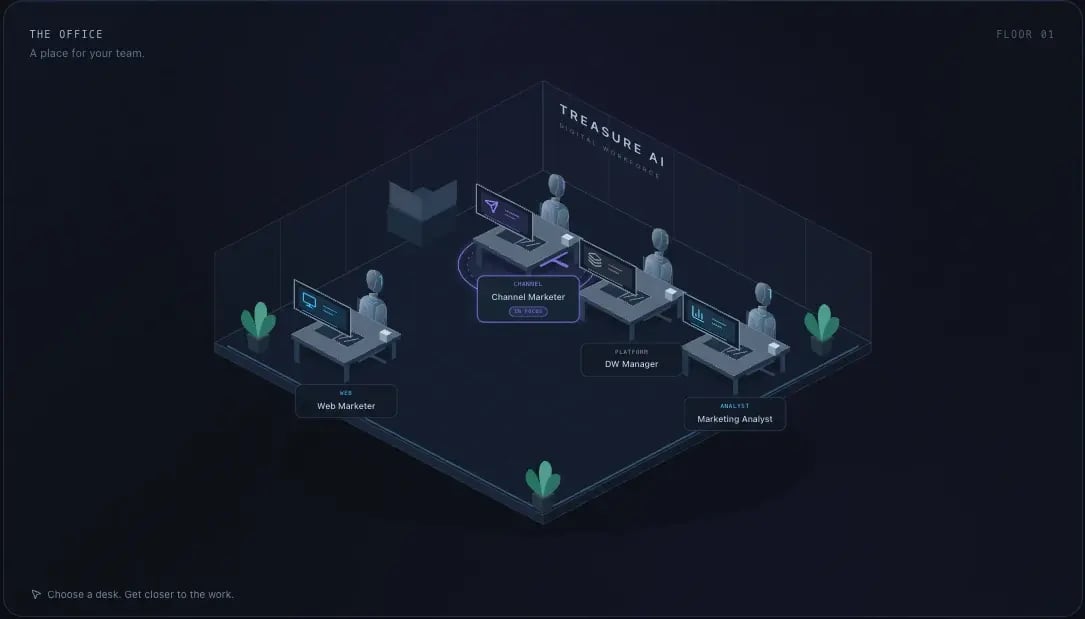
AI teammates for analysis, content, campaign operations, journeys, and optimization

Example roles · co-designed with our FDE

  • Marketing Analyst
  • Channel Marketer
  • Web Marketer

Treasure AI Platform

Treasure AI Studio

Headless AI workspace

Agent Gateway · APIs · MCP · Skills

Your team can also operate directly from Studio or preferred tools.

Platform capabilities, used as the task requires

Governed Customer Context

Customer Data Platform

  • Identity & profiles
  • Behavior & transactions
  • Consent & data quality
  • Content & voice
  • Data catalog & permitted data
  • Business ontology & agreed definitions

Reuse agreed definitions; fill task-specific gaps with our FDE.

Predict what may happen

  • Churn risk
  • Purchase propensity
  • Offer affinity
  • Lifetime value

AI Decision Engine

Choose the next best action

Personalization & Engagement

Engage + Personalization Studioor existing MarTech

  • Email & SMS
  • Push & in-app
  • Web personalization
  • LINE & connected channels
Customer responses + outcomes enrich Governed Customer Context / CDP
Forward-Deployed Engineer (FDE)Connect + govern · Define roles + review · Evaluate + improve
GuardrailsConsent · Permissions · Evaluation · Monitoring · Auditability
Conceptual architecture. Horizontal flow is representative, not a required sequence. Responses and outcomes return to governed customer context; this does not imply automatic model retraining. Channel examples depend on available integrations. FDE support and guardrails apply throughout.

Customer intelligence loop

Turn one finding into the next improvement.

A Marketing Analyst returns a report. Your team chooses a test; Channel and Web Marketers prepare it. Outcomes inform the next analysis.

One shared business question

“What explains the change in repeat purchases across markets—and where should we act first?”

The analyst’s output

A report to guide your next test.

Understand what changed, inspect the evidence, and choose the next test.

Example report · not customer results

Repeat-purchase trends by market

Market AMarket B
Example of a market-by-market trend comparison Schematic lines show how a report could compare two markets over time. Market A trends downward while Market B stays comparatively steady. The shapes are examples, not customer data, measured values, or actual findings.
Example chart — schematic trends, not customer data.
Comparison
Compare markets using matched cohorts and an agreed observation window.
Hypothesis to validate
Does the message promise something the page does not support?
Proposed test
Test a consistent message and landing page for the selected audience.

Evidence to review

  • SQL + query results
  • Metric definitions
  • Cohort checks

Your team’s decisionValidate the findings. Choose which market to prioritize—and which test to run next.

How your team uses it

Turn the report into the next test.

Example task sequence, not automatic routing. Your team approves customer-facing actions.

Marketing Analyst

Compare repeat-purchase patterns. Return findings and a test proposal.

Human decision

Your team chooses the market, audience, and test.

Channel Marketer

Create messages for the selected audience.

Web Marketer

Make agreed page changes to support the test.

Governed customer context

Campaign responses, page behavior, and purchase outcomes return to the shared context.

Results feed the next analysis. Your team decides what to refine.

Example operating model. Roles, tools, and review points are co-designed with our FDE.

Set direction—not every click.

You choose the goal, audience, and approvals. Digital Workers prepare the analysis and drafts within agreed boundaries.

Getting started

Start with a Marketing Analyst.

Start with our Marketing Analyst foundation. Ground it in your data model and business ontology, then validate the analysis together.

Our analyst foundation

Marketing Analyst

A structured analyst role—not a blank slate.

  • Analysis approach
  • Reusable skills
  • Task structure

Your business context

  • Data model

    Your tables, fields, and relationships.

  • Business ontology

    Your concepts, metrics, and agreed definitions.

  • Permitted data access

    The sources and scope the analyst may use.

Your Marketing Analyst

Grounded in your business.

The analyst foundation, applied to your data and definitions.

Ready for joint validation

Our FDE helps connect the two: map your data and ontology to the analyst foundation, and resolve gaps together.

From the analyst foundation to a recurring task

  1. Ground the analyst

    Your team shares the data model and business definitions. Our FDE helps map context, fill gaps, and agree access.

  2. Choose a first analysis task

    Agree one business question, the comparison to make, and what a useful answer should contain.

  3. Validate together

    Our FDE helps test SQL and results. Your business owner validates definitions, assumptions, and interpretation.

  4. Make it recurring

    When agreed quality criteria are met, set a schedule and review owner. Track quality, turnaround, and review effort.

Marketing Analyst first. Use reviewed findings to shape Channel or Web tasks when needed. Shared definitions help teams interpret findings across markets and agreed working languages.

Start with a Marketing Analyst

Your Marketing Ops or business owner leads the partnership with our FDE. An AI Marketing Ops function is optional.