Kaz Ohta opened his Agentic World 2026 keynote in Miami with a story about a summer intern. On day one, the intern suggested using a large language model to build the HTML email templates Treasure AI’s team was still editing by hand. A year later, many Treasure AI customers use the capability that grew out of that prototype. As Kaz put it, “creativity is everywhere.”
In the October 6 session, Human-Led, Built to Act: The Future of an Agentic Experience Platform, the Treasure AI CEO and Co-Founder explained why cheaper AI and AI-assisted consumers are changing marketing, and how Treasure AI plans to help brands respond with people setting the direction.
Key takeaways
- AI is getting cheaper faster than compute ever did. Kaz expects a task that costs $100 with AI today to cost about $1 within a year.
- Discovery is moving into AI. AI search answers and assistants that act for consumers are changing how buyers find brands.
- Customer context is the foundation. Treasure AI aims to close the loop from customer signal to engagement in real time, and to make that context reachable from the tools teams already use.
- Digital Workers are AI Teammates. They work alongside the team, stay governed, keep a human in the loop, and are always on. In a live demo, three example roles moved a campaign from insight to review-ready drafts.
- People stay in charge. Teams set each worker’s purpose, data access and permitted actions, and approve what goes out.
Why now: AI is getting cheaper and consumers are handing off tasks
Intelligence is becoming a commodity
As a computer science student, Kaz watched his professor build IBM’s Blue Gene, a supercomputer at Argonne National Laboratory that filled a space roughly twice the size of the keynote ballroom. Today, he said, a desktop AI system the size of a bento box sitting on his shelf is faster.
AI is commoditizing even faster than compute or electricity did. Kaz’s rule of thumb: a task that costs $100 with AI today will cost about $1 in 12 months. At CDP World a year earlier, he showed AI analyzing data and building segments and a journey in almost 15 minutes. That work now takes seconds. The industry focus has shifted from chasing the most capable model to intelligence per cost, a lesson Treasure AI learned when rolling AI out to every employee sent costs climbing and led the company to add cost controls.
Discovery is moving into AI
Consumers feel the shift first in search. Kaz cited data showing that when Google displays an AI Overview, the vast majority of searchers no longer click even the top-ranked result. Independent research supports the trend: Ahrefs found in 2026 that AI Overviews correlate with a 58% lower average click-through rate for top-ranking pages. [Link to Ahrefs study.]
Buyers are also asking AI directly. Before traveling to Miami, Kaz asked ChatGPT to pick a travel-friendly shaver for him. He expects B2B buyers are asking AI how Treasure AI compares with other CDPs, too. Treasure AI’s response is cdp.com, where AI agents track CDP vendors daily to keep a category encyclopedia current. Kaz said the site now earns substantial daily referral traffic from Google AI Overviews.
Assistants are starting to act
Most AI use still looks like search. The next wave takes action. Meta’s Muse, a personal AI agent app, reached No. 1 among free apps on the U.S. App Store after its September launch and passed 5 million downloads in about three weeks, according to Sensor Tower. Kaz described assistants like these booking tickets for a movie you are tracking once you say yes, or finding and canceling subscriptions you no longer use.
Now picture 5 billion internet users, each with an assistant acting on their behalf. That is the agentic traffic headed to every business. When consumer behavior changes this much, Kaz argued, company behavior has to change with it.
Customer context is the foundation for an agentic experience platform
Treasure AI manages more than two billion customer profiles in its CDP, which Kaz said makes the company and its customers custodians of the most critical data in the enterprise. That responsibility grows as AI begins acting on that data.
Over roughly 15 years, Treasure AI has built a data layer that brings customer context into one place, spanning batch and real-time data, composable architecture, zero-copy access and now open catalog access. The goal from here is to close the loop in real time: collect and unify customer data, understand it, decide what to do and engage, for billions of consumers and the AI assistants acting for them.
Context without extra copies
Working with partners such as Snowflake, Treasure AI now offers feature parity, including journeys and A/B testing, whether data lives in the CDP or in a customer’s warehouse. The Engage AI Suite can send campaigns without storing data inside the engagement tool, keeping governance at the warehouse layer. Open catalog access, through an Iceberg-format metadata API, lets Snowflake, Databricks and BigQuery query CDP data directly.
More context, shared across teams
AI also needs context beyond the CDP. Treasure AI has released connectors for Google Analytics, Google Search Console and cloud data warehouses, and Kaz asked customers to help prioritize what comes next, such as advertising platforms or email service providers. He also announced shared work folders in Treasure AI Studio, which let people working in the same project share AI memory, so knowledge an expert builds stays available to new colleagues.
Headless: Treasure AI where work already happens
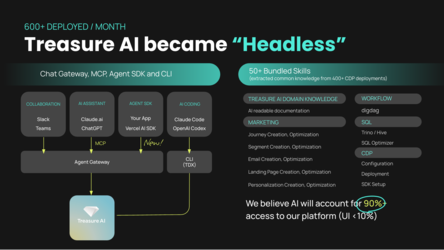
Kaz estimated that 95% to 99% of platform access today comes from people. He expects most future access to come through AI, often working on a person’s behalf. Treasure AI is making its platform headless so customers can reach its capabilities from the tools and AI environments they already use.
- tdx: A command line tool that sits over more than 70 microservices and hundreds of API endpoints and lets users operate the platform in natural language. It is developer-focused, but AI can use it to surface features people rarely find on their own. Rafa Flores’s demo earlier in the day was built on it.
- Agent Gateway: For customers who want vendor-neutral AI and business users who want to stay in familiar tools, Kaz announced Agent Gateway, starting with Slack and Microsoft Teams connectors. A remote MCP server for Claude and ChatGPT Enterprise is in development, and Kaz described embedding Treasure AI capabilities into custom applications through the Vercel AI SDK.
- Bundled skills: Connectivity alone is like sitting in a cockpit without knowing which switch to flip. Treasure AI is packaging expertise from more than 400 CDP implementations into skills for building journeys, emails and landing pages, writing and optimizing SQL, configuration, deployment and SDK setup. External AI tools such as Claude or Codex can download those skills and start working with the platform immediately.
Digital Workers: AI Teammates
Kaz called those platform updates incremental. The bigger question is what becomes possible when AI work that costs $100 and takes 100 seconds today costs $1 and takes one second. A year ago, he talked about small agents doing small tasks; those became the skills Treasure AI now ships. With cheaper, more capable intelligence, complex work close to data and software is within reach. Treasure AI Digital Workers are built for that: AI that takes on an ongoing responsibility rather than waiting for the next prompt.
Treasure AI’s launch line: At Agentic World, we announced Digital Workers, your AI Teammates that are always on, governed, and keep a human in the loop.
Each Digital Worker is an AI Teammate built from a folder of prompts, skills, scheduled tasks and actions, with a persona file that defines its role, how it thinks, its goal and its success criteria. Kaz introduced three example roles:
- Marketing Analyst: Reviews CDP data every day, reports what changed and turns findings into segments for a person to approve.
- Channel Marketer: Builds customer journeys and keeps improving them based on campaign results.
- Web Marketer: Publishes approved Engage landing pages, proposes edits to cdp.com and drafts Personalization Studio experiences for review.
The idea is for teams to add Digital Workers alongside their people, as AI Teammates that are always on, so marketing work keeps moving.
Inside the demo: from an audience shift to a campaign plan
The Marketing Analyst spots a change and proposes a plan
Kaz asked the Marketing Analyst what was happening in the data. It flagged that on September 27, an audience of deep category explorers jumped from about 400 to just over 500 profiles in a single day. Investigating further, it traced the spike to a statistics and trends article featured on a CDP basics hub, which sent readers into a vendor guide and a how-CDPs-work explainer. Exposure for the article and the audience rose and fell together, pointing to a temporary discovery wave.
With Agentic World approaching, Kaz asked what to do next. The analyst wrote and ran its own SQL, then recommended turning the discovery wave into an event invitation: an email to the engaged readers, a supporting explainer on shared customer profiles and homepage banners promoting the event. It handed the email to the Channel Marketer.
The Channel Marketer drafts the invitation
Before writing, the Channel Marketer checked with the analyst on angle and goal. The answer: lead with practical AI and customer data sessions, make free registration the clear next step and judge success by registrations. The Channel Marketer then built the email and campaign in Engage through natural-language access to Treasure AI’s APIs. It could not send without approval, so the draft waited for a person to review and send. Kaz estimated this approach can cut 70% to 80% of the cost of running a campaign.
The Web Marketer builds the supporting experience
The Web Marketer, permitted only to create landing pages and work in Personalization Studio, drafted a page explaining shared customer profiles in plain terms. It set the page to noindex so it would support the campaign without competing with the cdp.com guide in search, and left it unpublished for review. It then created two cdp.com homepage banner variants, one for readers who explored deeply in a single visit and one for readers who returned over several days, and flagged that the preview still needed a rendering check before launch. Kaz noted that a worker like this could keep optimizing A/B tests over time.
The point was not agents chatting. It was work moving from role to role, each within defined permissions, with a person directing and approving every step.
People set the direction and the boundaries
Kaz treats AI safety as an engineering problem: AI without permissions cannot do anything. Each Digital Worker runs in its own secure, containerized environment with its own guardrails, and every network connection and file access is traced and audited. Teams decide each worker’s purpose, what data it can see, what it can do and which decisions stay with people.
Kaz was candid about where adoption starts. Workflows like email journeys involve many teams, so the strongest early interest is in analytics, where a Digital Worker can study data around the clock. Language helps too: some customers run their CDP across 60 to 70 countries, and a Digital Worker can support multiple markets without a separate team for each.
He closed with a bold prediction. In engineering, hand-writing code is giving way to providing guidance and principles for architecture, design and testing. Kaz expects the same shift in every department, predicting that within 12 to 15 months, no one will hand-build a segment or journey. What remains with people is guidance and judgment.
The road ahead
Kaz’s message was that the future of marketing is human-led and built to act: people setting direction and making the calls that matter, with AI doing more of the work in between. Watch the full keynote above to see the Digital Workers demo in action.
Frequently asked questions
What is an agentic experience platform?
It is how Treasure AI describes its platform: a customer data foundation that unifies customer data and uses AI to act on it, closing the loop from customer signal to engagement in real time under human direction.
What are Treasure AI Digital Workers?
Digital Workers are AI Teammates. They are Treasure AI’s vision for AI that takes on ongoing marketing work rather than answering one request at a time. Each combines prompts, skills, scheduled tasks and actions with a persona that defines its goal and success criteria. At Agentic World, Kaz illustrated the concept with three example roles: Marketing Analyst, Channel Marketer and Web Marketer.
Do Digital Workers act without human approval?
No. In the keynote demo, the workers analyzed data and prepared drafts, but a person directed the work and approved outcomes. Teams define what each worker can access and do, and every worker’s activity is traced and audited.
How can teams use Treasure AI from other tools?
Through headless access. Kaz described the tdx command line tool, Agent Gateway (starting with Slack and Microsoft Teams, with a remote MCP server for Claude and ChatGPT Enterprise in development) and bundled skills that teach external AI tools to work with the platform.