From Idea to Customer Experience: Rafa Flores at Agentic World
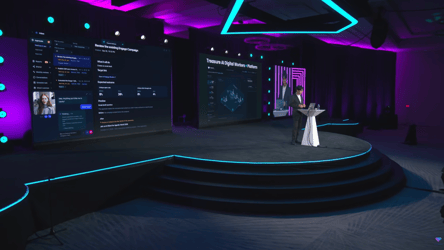
Rafa Flores’s guest on the Agentic World 2026 main stage had never used Treasure AI, apart from a 6 a.m. rehearsal that morning. She had an idea for a loungewear brand called In Good Company. Over the next half hour, with the audience as her test market, that idea became a brand, two audiences, a customer journey, personalized emails and personalized landing pages, built live on hotel Wi-Fi.
Rafa, Chief Product and Growth Officer at Treasure AI, gave the session, From Fragmented Data to Everyday Magic: How AI Becomes Human in Real Customer Experiences, on October 6, 2026, in Miami, before introducing CEO Kaz Ohta. He used it to launch Personalization Studio and announce engagement-based pricing for email.
Key takeaways
- People stay accountable, so they stay in control. Rafa argued that AI should eliminate wasted motion, not the judgment of the people who answer for the results.
- Each step built on the last. In Treasure AI Studio, the brand informed the audiences, the audiences shaped the journey, and both drove the emails and landing pages.
- Simulate before you spend. A Treasure AI Labs simulation compared three journey strategies before launch, and the more complex option did not win.
- Personalization Studio is generally available. Marketers can tailor landing-page images, headlines, copy and CTAs to each audience.
- Email pricing now follows engagement. Treasure AI is tying email costs to customer actions, such as clicks, rather than send volume.
Always on, without always-on people
Rafa framed the event around one question: what will you build? At CDP World a year earlier, Treasure Data promised that agents would take on much of the work, and many customers have since deployed their own. But he said the industry skipped a step. Basic work like building the right audience still takes days, and teams need to get those foundations right before they open up data access and let agents run.
The work is not disappearing, he said; the goal is to eliminate wasted motion. That raises the question of who decides what an agent does. Rafa’s answer: “when you have an agent do something on your behalf, they did it on your behalf. So the accountability is still on you.” Control and judgment stay with people, so AI can be always on while people are not.
He then said the demo would show the Customer Intelligence Loop (collect, unify, understand, decide, engage) working live.
The demo: from idea to customer experience
Rafa staged the demo as a startup hiring its first team. Treasure AI team members joined one at a time to own brand and audiences, journeys, email and web, while Lead Product Designer, Andrew, typed every prompt into Treasure AI Studio live, typos included.
Step 1: Turn a brief into a brand
The guest wanted crewnecks comfortable enough to work in and presentable enough to wear out, aimed at Gen Z and people who follow Gen Z trends. The team asked Treasure AI Studio for a brand identity for a sustainable Gen Z crewneck brand, with positioning, values and creative direction.
Back came a brand board: a new logo, the line “Made to be lived in,” typography, a color palette, a warm and self-aware brand voice, and four pillars (comfort, connection, expression, responsibility). The guest said it matched her vision.
Step 2: Let the audience define the segments
Sometimes your best audience is one you do not know yet, Rafa said. Many attendees were once 22 and shopping for brands like this, so Treasure AI surveyed them before the session, and 155 responded. Former Olympic goalkeeper Karina LeBlanc offered her own answer from the floor: at 22, she wanted sporty, casual and fun.
An audience dashboard showed the results: cool and earthy palettes, comfort and style as purchase drivers, medium-to-high crewneck affinity, and classic or sporty style at 22. Using affinity, how strongly someone resonates with something, the team built two audiences:
- Launch Crew (126 respondents): likely to be interested in the brand now.
- Rediscovery (29 respondents): lower crewneck affinity, but a style at 22 that fits the brand, making nostalgia the hook.
Step 3: Compare journey strategies, then simulate them
The team asked for three journey strategies with a channel mix and rationale for each, a capability Rafa said was new as of a few weeks earlier:
- Direct reach: a personalized email.
- Connected experience: a personalized email leading to a personalized web page.
- Always on: email, web page and a follow-up SMS.
A journey simulation in Treasure AI Labs, the company’s space for experimental capabilities, then used an AI decisioning model to estimate how the 155 respondents might respond to each. It recommended Connected experience for its better click-to-send ratio and slightly better engagement. Rafa admitted he would have bet on the most complex option, but “guesses are not always right.” The simulation estimated likely responses; it did not measure campaign results.
Step 4: Build the journey
The team built a Brand Discovery journey on the Connected experience strategy, with branches for Launch Crew, Rediscovery and attendees who skipped the survey. Each branch sends a personalized email that leads to a personalized web page. In Rafa’s words: one journey, different stories.
Step 5: Personalize the emails
Treasure AI Studio generated email templates using audience attributes and the brand guidelines: four Launch Crew variants keyed to purchase driver, four Rediscovery variants keyed to style at 22, and a generic version for anyone without survey data. After the guest approved them, the templates became email campaigns.
Step 6: Personalize the landing page in Personalization Studio
The team had prepared a base landing page with the guest before the session. In Personalization Studio, they marked four content spots to personalize: headline, supporting text, CTA and hero image. The agent then generated variants of each for Launch Crew and Rediscovery, tied to purchase driver and style, and the team created two landing-page campaigns. Visitors without survey data saw the base page.
Step 7: A governed launch
Nothing went out until the guest counted down. “Because it has to be governed, and she’s in control,” Rafa said. “Our human in the loop is in control.”
The same brand, different experiences
The emails reached attendees in the system, survey or not, with CTAs leading to the landing pages. Rafa asked the room to check their phones and called up a volunteer.
She had chosen bold colors in the survey, and seeing how few others had, she assumed she would not be represented. Her email came in those bold colors, in a style she said was right on target.
Rafa used the moment to challenge a familiar rule: “you have to be on brand for the person who’s buying from you.” The brand stays the same; the people, and their experiences, differ. He also joked that he would leave the room’s clicks out of his performance marketing report, since he had asked for them.
Personalization Studio is now generally available
Rafa announced general availability on stage, describing Personalization Studio as a studio for web personalization that anyone on a marketing team can use. According to Treasure AI’s launch announcement, it runs directly on the company’s customer data foundation, combining profile data with real-time behavioral signals, so there is no separate profile store, export-and-sync process or data pipeline to maintain. It is part of the Personalization AI Suite within Treasure AI’s agentic experience platform.
Engagement-based pricing: paying for clicks, not sends
Rafa raised the “SaaS is dead” debate without taking a side, then asked: if SaaS is dead, why do vendors still charge like SaaS companies? Vendors sell task completion, he said, but nobody gets promoted for completing tasks. People get promoted for the value they add.
His announcement: Treasure AI is introducing an alternative to send-based email pricing. Customers can continue to use the existing model, where one AI Credit covers one million emails sent, or choose engagement-based metering, where one credit covers 20,000 email engagements, such as clicks. Initially available for email, the model gives customers a choice between paying for message volume and paying for engagement.
The move fits a broader shift. Gartner predicts that by 2030, at least 40% of enterprise SaaS spend will move toward usage-, agent- or outcome-based pricing.
This new engagement-based pricing also reflects a broader idea: better use of customer data should lead to better engagement. Treasure AI uses customer data to build AI Signals into email campaigns, helping marketers send the right email to the right audience, with the right message, at the right time. By making campaigns more relevant, AI Signals can help increase engagement while reducing wasted email activity. As Rafa put it: “Give AI a purpose.”
What will you build?
Rafa closed by bringing his guest back. She had gone from an idea to a customer experience in one conversation, and he asked the room what they would build in her place. His parting line: “Be your own CEO every day.” Watch the full session above to see the demo unfold.
Make every website visit more relevant. CTA: Explore Personalization Studio
Frequently asked questions
What is Treasure AI Personalization Studio?
Personalization Studio is a marketer-facing workspace in Treasure AI for building, launching and managing real-time website personalization. Marketers pick a page, select content spots such as the headline, supporting copy, CTA and hero image, choose the audiences to target, and review AI-proposed creative before launch. It runs on Treasure AI’s customer data foundation without a separate profile store, and it is generally available to Treasure AI customers as part of the Personalization AI Suite.
What is engagement-based pricing for email?
Engagement-based pricing is Treasure AI’s model for charging for email based on customer engagement, such as clicks, rather than the number of messages sent. Rafa Flores announced it at Agentic World 2026, arguing that vendors should be paid for the value they help create, not for task completion or send volume. Under send-based pricing, a brand pays the same whether or not anyone engages; under this model, costs track what customers do with the email.
Can marketers test journey strategies before launching?
Treasure AI demonstrated this at Agentic World 2026 using a journey simulation in Treasure AI Labs. The team generated three journey strategies (email only; email plus a personalized landing page; and email, landing page and SMS), then simulated how 155 surveyed attendees might respond to each using an AI decisioning model. The simulation recommended the email-plus-landing-page journey over the more complex option. Labs capabilities are experimental, and simulated outcomes are estimates of likely responses, not measured campaign results.
Who stays in control when AI runs marketing work?
People do. Rafa Flores argued that because agents act on a team’s behalf, the team remains accountable for the results, so it should keep control and apply its own judgment. The goal is for AI to be always on without people having to be. In the Agentic World demo, AI generated the brand, audiences, journey, emails and landing pages, but a person approved each output, and nothing launched until she gave the go-ahead.