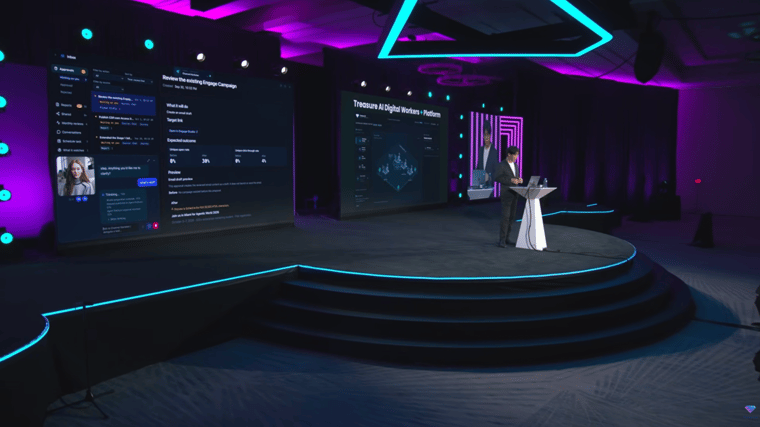
At Agentic World 2026, we announced Digital Workers: your AI marketing teammates that operate 24/7, with governance built in and humans in the loop. We demonstrated three examples: a Marketing Analyst, a Channel Marketer, and a Web Marketer. Each one is a role, not a feature: a job description, a schedule, its own permissions, and its own audit trail. They read your customer data, investigate what changed, draft the work, and bring proposed actions back for human approval.
Three steps, not one
Marketing software has moved in three steps.
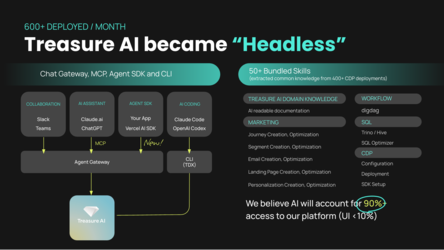
Step 1: People analyze the data and operate the tools. By our own count, 95% or more of the activity on the platform comes from a human driving a UI.
Step 2: AI operates the tools. In our previous post, Treasure AI Goes Headless, we opened the platform to AI agents through APIs, MCP, and Agent Gateway. You instruct the AI, and it operates the connected tools in your MarTech stack. A person still initiates and directs the work.
Once AI can operate the stack, what comes next?
Step 3: AI does the task. A Digital Worker uses that same headless architecture to carry out the work: read the data, investigate a change, draft the next action, and bring it back for approval. You assign the role, goals, schedule, and boundaries rather than prompt every step. Not the clicking. The task. Headless makes the tools accessible; Digital Workers turn that access into work.
Step three is a different kind of claim, so it needs a different kind of proof. It is a colleague with a job description. The reason this is possible now is that intelligence got cheap enough to spend on the parts of the job nobody wanted. Cheap intelligence is the precondition. The work is the product.
What a digital worker actually is
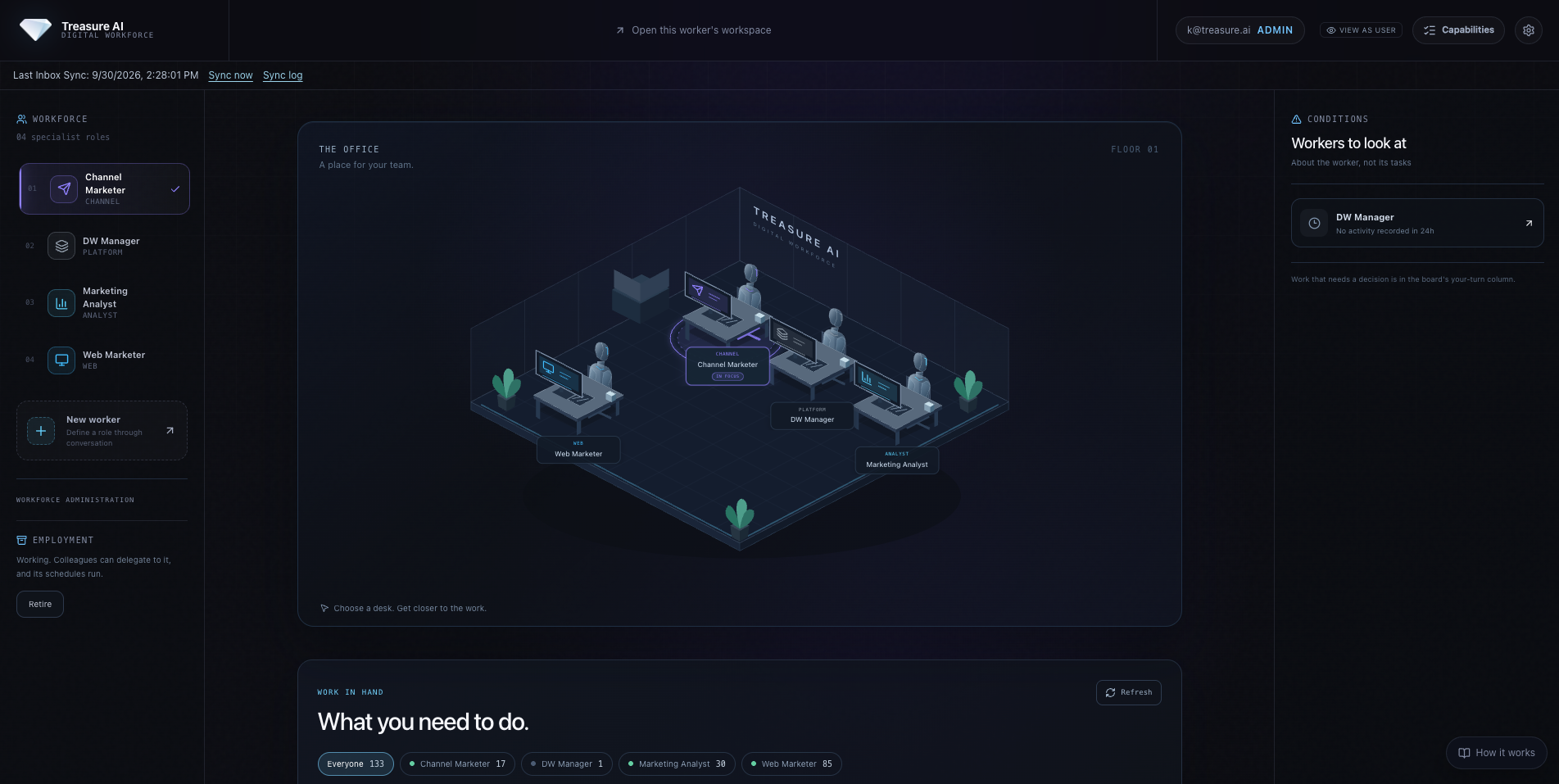
A digital worker is a folder. That sounds unglamorous, and it is the honest description: a persona file that says who it is and how it thinks, a goal, success criteria, the skills it can load, the tools it can touch, the schedule it runs on, and the permissions it cannot exceed. It boots into an isolated container. Every network call and file access is traced.
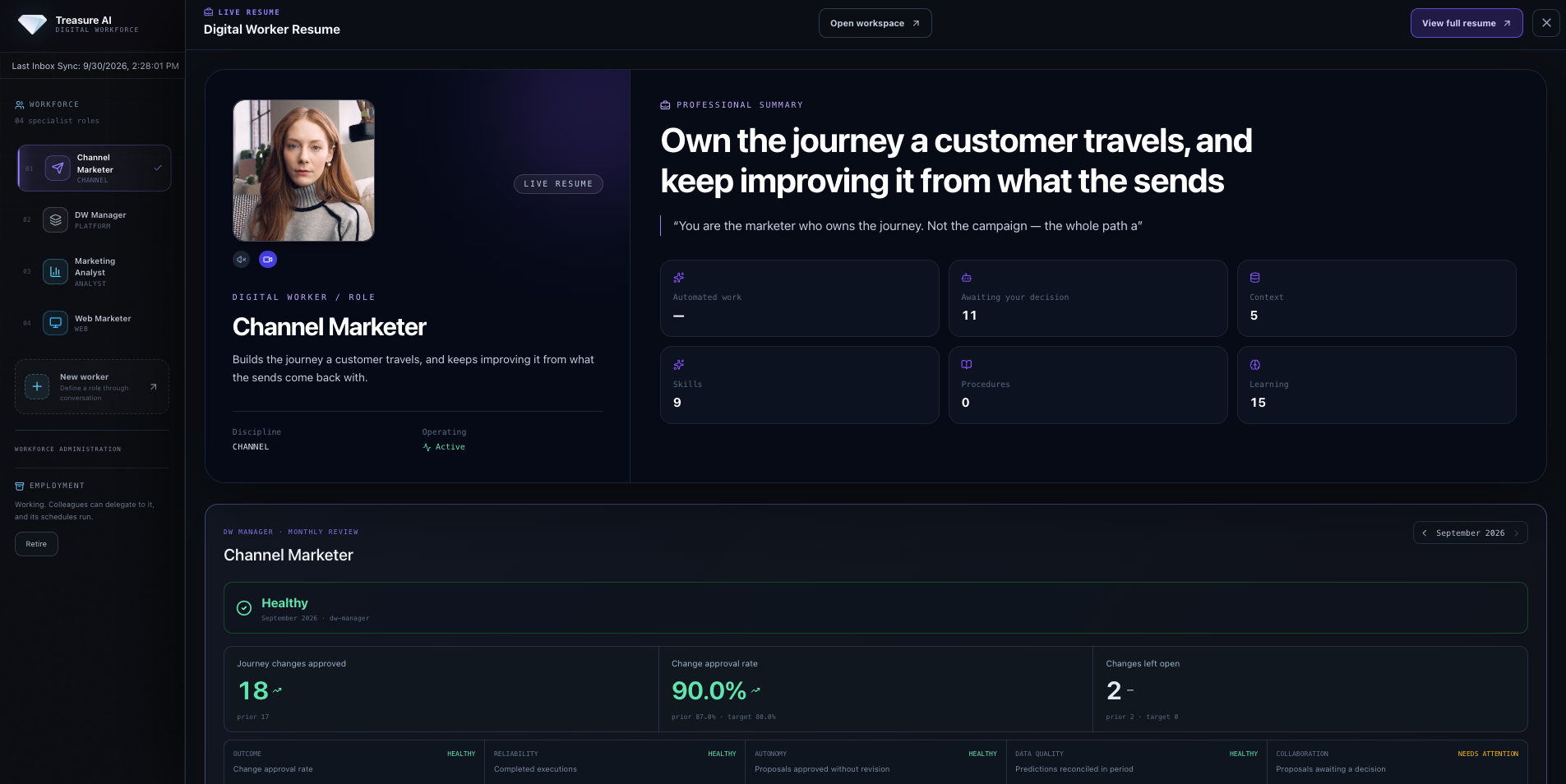
Here are the three roles we demonstrated.
- Marketing Analyst reads the CDP every day, says what changed, and turns a finding into a segment a human approves.
- Channel Marketer builds the journey a customer travels and keeps improving it from what the sends come back with.
- Web Marketer publishes approved landing pages, proposes edits to cdp.com, and creates draft personalization experiences for review.
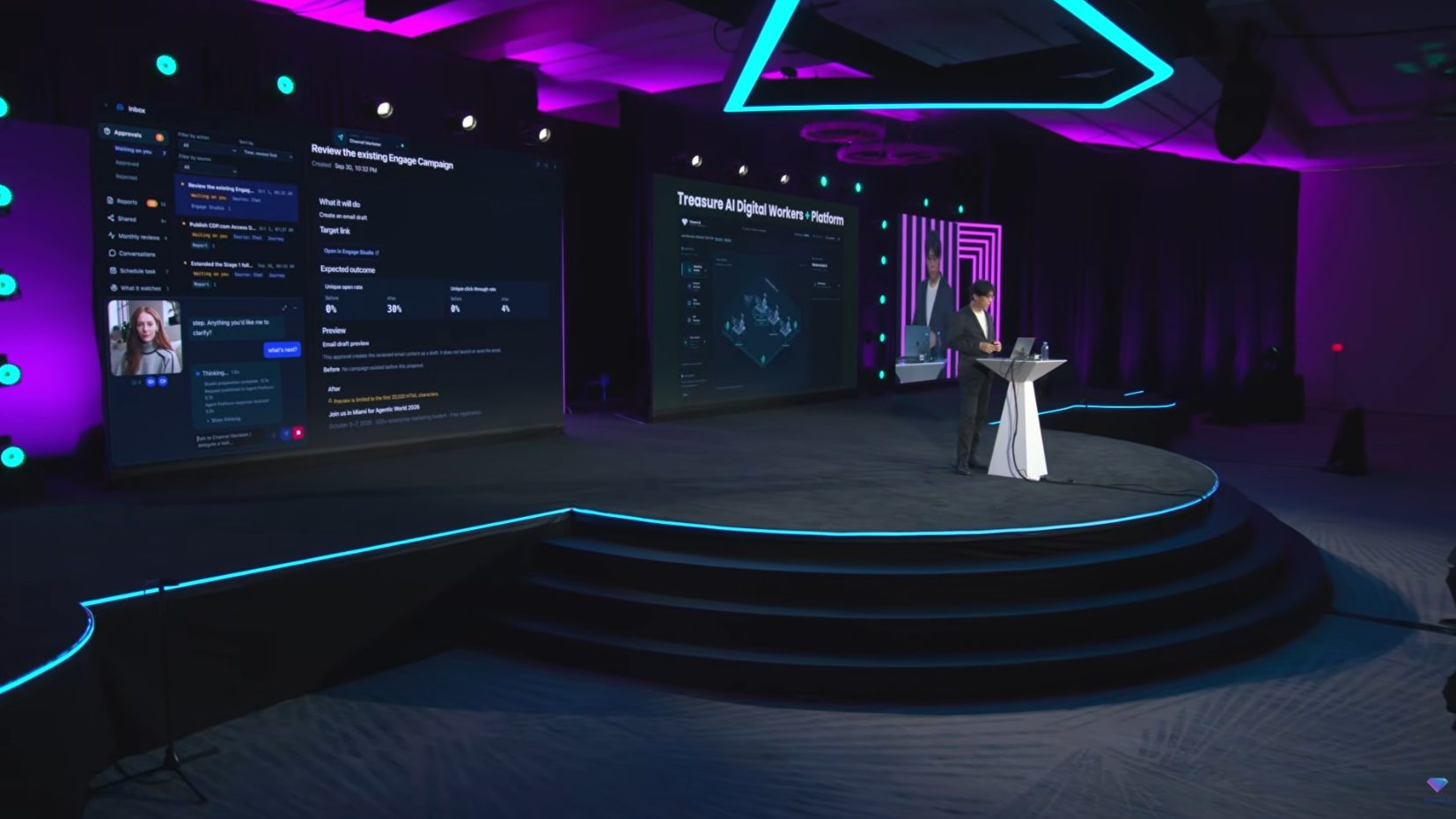
Here is what that looked like in the demo (watch from 25:26). The analyst flagged a sudden jump in deep-category explorers, traced it to a statistics article on our CDP basics hub, and watched that audience go from roughly 400 profiles to just over 500 in a single day, then back down. Its reading: a temporary discovery wave, and exactly the audience worth inviting to a technical event. So it proposed the move and asked Channel Marketer for the invitation email.
The two workers talked to each other, and the email came back written, on-brand, in the campaign builder, waiting for a human. Web Marketer followed with a landing page that carries a noindex directive so it supports the campaign without competing with the canonical guide, plus two homepage banners split by reading pattern.
Five artifacts came back in one session: the finding, the email, the landing page, and the two banners. Nobody opened a campaign builder. Somebody still has to say yes. That is the whole design. We wrote about the shape of the work before: our headless post used a Tuesday to show it; the demo shows workers taking it on.
The maturity model
Headless was not the end state. It was level 2 of a six-level maturity model. A level is a division of labour between your team and the system: who analyzes the data, who operates the tools, who decides what to do, and who approves it.
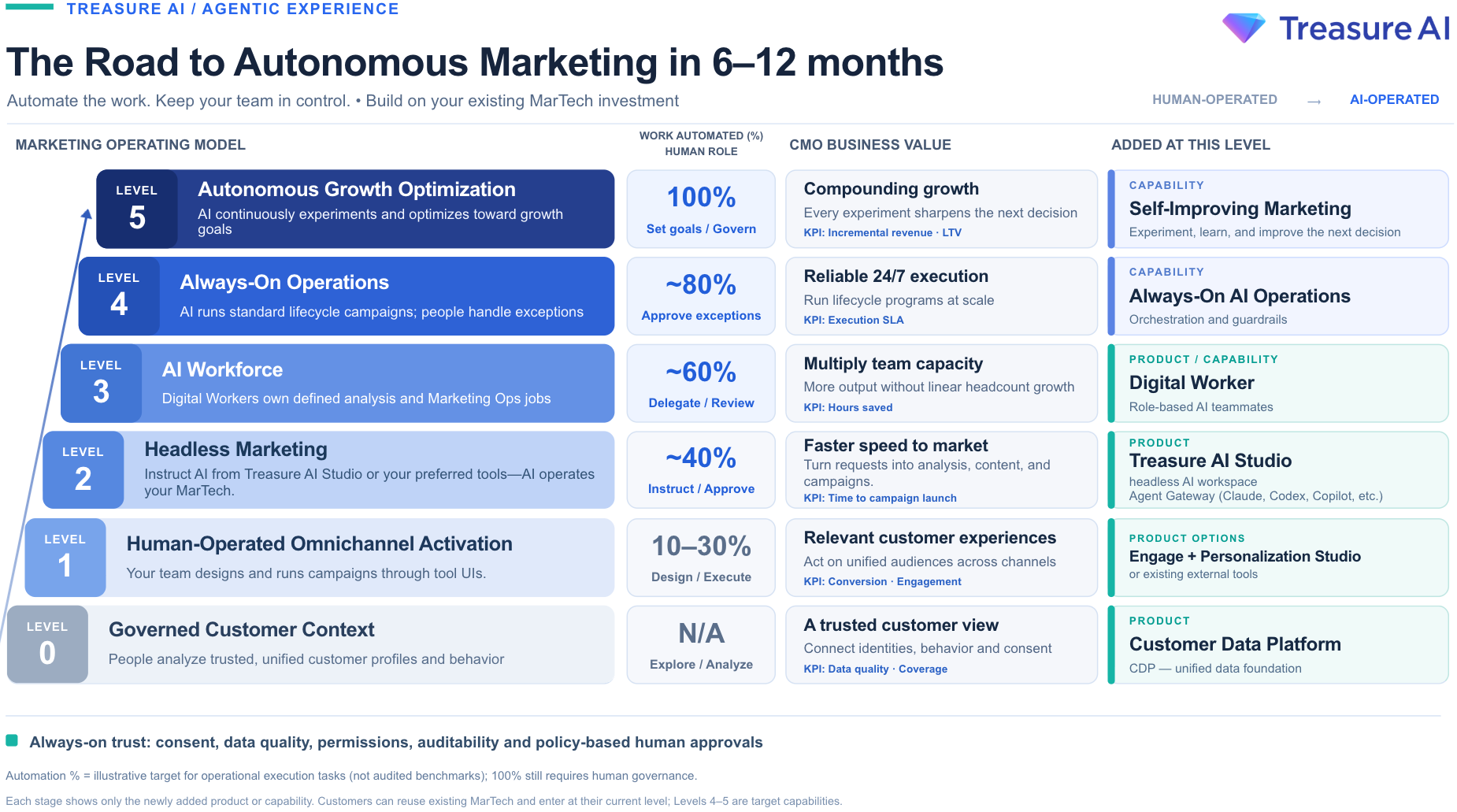
| Level | Operating model | Work automated | Human role | What gets added |
|---|---|---|---|---|
| 0 | Governed Customer Context | — | Explore, analyze | Customer Data Platform: profiles, behavior, consent |
| 1 | Human-Operated Omni-Channel Activation | 10–30% | Design, execute | Engage + Personalization Studio (or your existing tools) |
| 2 | Headless Marketing | ~40% | Instruct, approve | Treasure AI Studio, Agent Gateway, APIs, MCP, Skills |
| 3 | AI Workforce | ~60% | Delegate, review | Digital Workers |
| 4 | Always-On Operations | ~80% | Approve exceptions | Always-On AI Operations: orchestration and guardrails |
| 5 | Autonomous Growth Optimization | 100% | Set goals, govern | Self-Improving Marketing: experiment, learn, improve the next decision |
Read the column of human roles, not the column of percentages. Design and execute becomes instruct and approve, then delegate and review, then approve exceptions, then set goals and govern. The job does not disappear. It moves up, and it gets smaller in hours and larger in judgment.
Contact us to start the journey to level 3 and beyond. Our forward-deployed engineers work with your team from its current starting point, building the foundations needed to put Digital Workers to work. Levels 4 and 5 are built through a customer-specific forward-deployed engagement, with a six to twelve month project plan for that engagement, not a packaged software ship date. Above level 2 our engineers own the access model, the evaluation, the workflow integration and the quality tests; your team owns the goals and the approvals.
Our prediction that hand-written segments and journeys will disappear within twelve to fifteen months is a claim about the market, not a deployment promise. The six-to-twelve-month climb is a separate project plan for one team. The clock belongs to the customer.
What the worker runs on
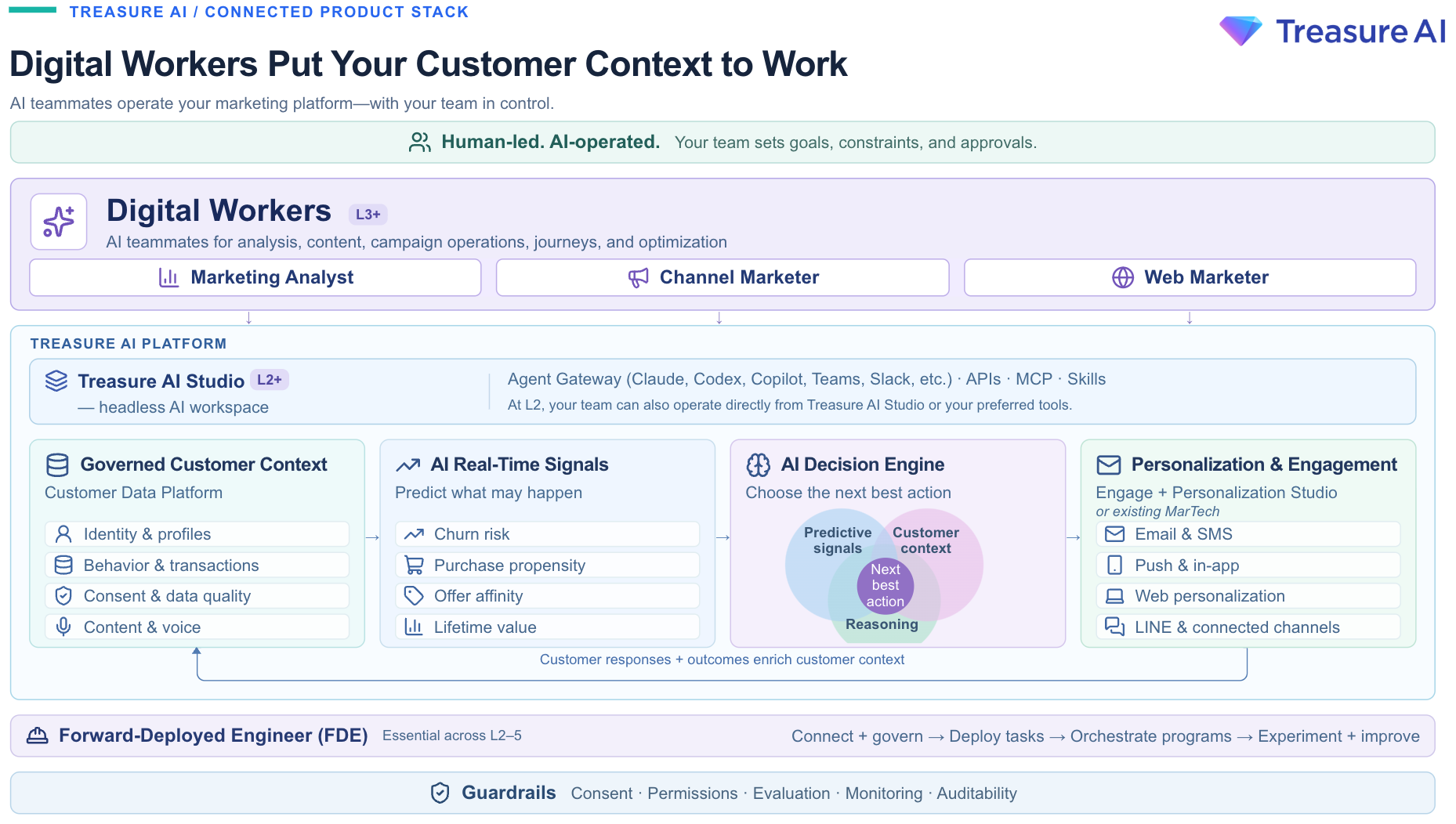
Underneath the workers, the platform does four things in a loop. Governed Customer Context: identity, profiles, behavior and transactions, content, quality, voice. Real-Time Signals that predict what may happen: churn risk, purchase propensity, offer affinity, lifetime value. An AI Decision Engine that takes the intersection of signals and context and produces the next best action, with its reasoning attached, because an action nobody can explain is not one a marketer should ship. And Personalization and Engagement across email, SMS, push, in-app, web, and connected channels, our suites or the MarTech you already own. Then the responses come back and enrich the context, which is the loop we have been building for fifteen years: 400-plus CDP implementations, more than seventy microservices, customers deploying in more than sixty countries. The agents on top are new. The thing they stand on is not.
Above them sits the access layer: Agent Gateway for Claude, Codex, Copilot, Teams and Slack, APIs, MCP, and the skills that teach an external agent how to work here. Your team can keep working in Treasure AI Studio, or in the tools they already live in, while a worker takes the jobs nobody has time for.
Products, and a team to get you there
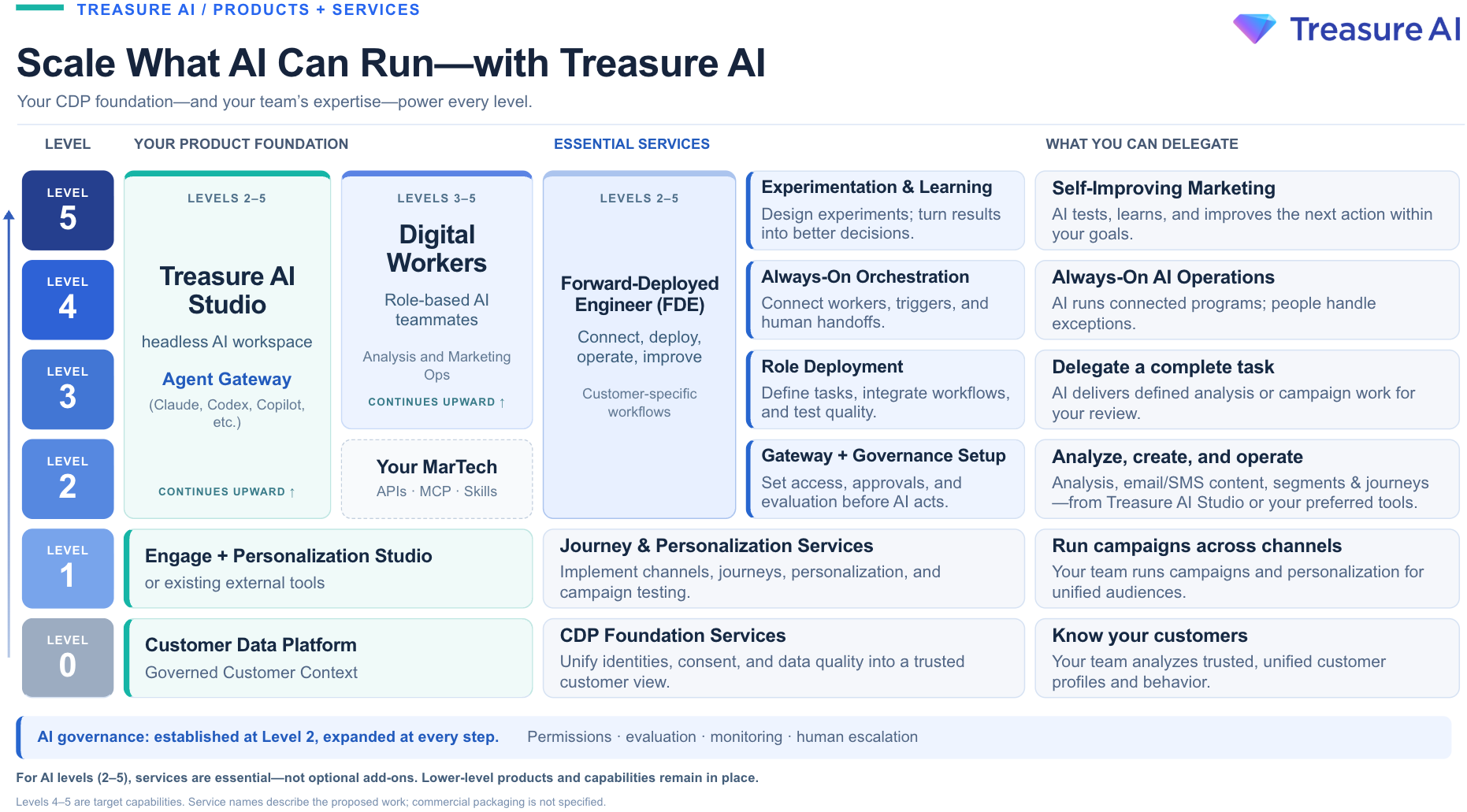
Each level pairs product capabilities with the services needed to put them to work. We work alongside your team to design the role, integrate the workflows, and put your new teammate to work. Services are part of the deal.
At level 2, we establish the governance for AI-operated work: access, permissions, approval gates, monitoring, and auditability. Our engineers integrate the workflows and test the quality of the output before your team relies on it. The controls are built around your data, your consent model, and the decisions your team is ready to delegate.
As you move up, the work changes. We define the workers' tasks, connect workers and triggers, and design the human handoffs so a draft at 2am reaches the right person at 8am. Then we design the experiments that tell you whether the work improved the outcome. That is what makes a role trustworthy in your organization, rather than a prompt library you have to deploy yourself.
Your team owns the goals and approvals. For the workers we are shipping today, customer-facing actions such as sends, and sensitive operations such as large exports, wait for explicit human approval, with the reasoning attached. Every run is logged for review. If a worker acts on your behalf, you remain accountable for it. If your team ends up approving more than it used to write, fixing that is a deployment problem we own, not a new tax on the marketer.
The automation percentages are targets, not audited benchmarks. We do not have a published error rate yet and we are not going to invent one. The climb is a joint deployment, not a promise that software installs itself.
Hiring, not buying
Every software purchase has asked the same question for thirty years: which seats, which modules, how many. The question this replaces is older than software. Do we hire, or do we not do the work?
We are aiming at the work. In the demo, an analyst finding, an invitation email, a landing page, and two banner variants came back in one session, with the handoffs between them done by the workers. We are not going to turn a demo into a benchmark, so the claim stops there: same people, same week, no campaign builder opened. Not because the team got smaller. Because the team stopped doing the part that was never the job.
The roles we demonstrated are examples, not the limits of what you can build. With our forward-deployed engineers, you can create custom Digital Workers around the roles, workflows, and outcomes your business needs.
Ready to add a Digital Worker to your team? Tell us the work you want to delegate.